Fang language
Fang language
Jump to navigation
Jump to search
| Fang | |
|---|---|
| Pangwe | |
| Faŋ, Paŋwe | |
| Native to | Equatorial Guinea, Gabon, Republic of the Congo, Cameroon, and São Tomé and Príncipe |
| Ethnicity | Fang people |
Native speakers | 1 million (2006–2013)[1] |
Language family | Niger–Congo
|
| Dialects |
|
| Language codes | |
| ISO 639-2 | fan |
| ISO 639-3 | fan |
| Glottolog | fang1246[2] |
Guthrie code | A.75,751[3] |
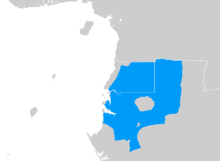 | |
Fang /ˈfɒŋ/ is a Central African language spoken by around 1 million people in Cameroon, Gabon, Equatorial Guinea, São Tomé and Príncipe, and the Congo Republic. It is the dominant Bantu language of Gabon and Equatorial Guinea. It is related to the Bulu and Ewondo languages of southern Cameroon. Fang is spoken in northern Gabon, southern Cameroon, throughout Equatorial Guinea, in the Republic of the Congo, and small fractions of the islands of São Tomé and Príncipe. Under President Macías Nguema, Fang was the official language of Equatorial Guinea.
There are many different variants of Fang in Gabon and Cameroon. Maho (2009) lists Southwest Fang as a distinct language. The other dialects are Ntoumou, Okak, Mekê, Atsi (Batsi), Nzaman (Zaman), Mveni, and Mvaïe.
Contents
1 Corpus and lexicology
2 Phonology[5]
2.1 Vowels
2.1.1 Diphthongs
2.2 Tone
2.3 Consonants
3 Phrases
4 See also
5 References
6 External links
Corpus and lexicology[edit]
Despite lacking any truly certain corpus of Fang's literary body, it is of note that linguists have, in the past, made attempts to compile dictionaries and lexicons for the Fang language. The two most notable ones to be either proposed or fully compiled were made by Maillard (2007)[4] and Bibang (2014). Neither created a direct Fang-English dictionary, but opted instead to separate the two languages via a third European language as a bridge for various loanwords.
The translation efforts to English have been done through Romance languages: specifically, Spanish and French. The latter of the two languages would likely have had the most impact on the language, given the occupation of Gabon by the French during the existence of French Equatorial Africa (itself part of French West Africa), which lasted 75 years from 1885 to 1960. To a lesser extent, in São Tomé and Príncipe, Portuguese also likely has influenced the dialects of Fang present there, due to the country being occupied by Portugal for most of the islands' history of habitation.
Phonology[5][edit]
Vowels[edit]
Fang has 7 vowels, each of which can have short or long realizations.
Front (short/long) | Back (short/long) | |
|---|---|---|
Close | i iː (ĩ) | u uː (ũ) |
Close-mid | e eː (ẽ) | o oː (õ) |
Open-mid | ɛ ɛː (ɛ̃) | ɔ ɔː (ɔ̃) |
Open | a aː (ã) | |
Nasal vowels are allophones of the respective oral vowels, when followed by a nasal consonant [ŋ] or [ɲ]. Words can not start with [ɛ], [i], [ɔ] nor [u].
Diphthongs[edit]
Diphthongs can be a combination of any vowel with [j] or [w], as well as [ea], [oe], [oa], [ua].
Tone[edit]
Fang distinguishes between 4 different tones, conventionally called: high, low, rising and falling. The former two are simple tones, while the latter are compound tones. One vowel in a sequences of vowels can be elided in casual speech, though its tone remains and attaches to the remaining vowel. [6]
Consonants[edit]
In Fang, there are 24 plain consonants. The majority of them can become prenasalized:
Labial | Dental | Alveolar | Alveopalatal | Velar | Glottal | |
|---|---|---|---|---|---|---|
Nasal | m | n | ɲ | ŋ | ||
Stop | p b mp mb | t d nt nd | k ɡ ŋk ŋg k͡p ɡ͡b ŋk͡p ŋɡ͡b | ʔ | ||
Affricate | t͡s d͡z nt͡s nd͡z | |||||
Fricative | f v ɱf ɱv | s z ns nz | h | |||
Approximant | l | j ɲj | w nw | |||
Tap | ɾ |
/h/ is only used in interjections and loanwords.
Words can not start with /ŋ/, except when followed by a velar consonant. /ɾ/ and /z/ also are restricted from word-initial position. /g/ and /p/ can only come in word-initial position in words of foreign origin, although in many of these cases, /g/ becomes realized as [ŋg].
The morpheme "gh" is pronounced as ɾ in the case of the word "Beyoghe" (the Fang term for Libreville); one of several changes to pronunciation by morphology.
It is also important to note that in Fang, at every "hiatus" (shock of two vowels), such as in "Ma adzi", it is required for one to make the second word an aphetism, dropping the pronunciation of the aː sound at the start of the second word (e.g. "Ma dzi") in order to make grammatically correct sentences.
Phrases[edit]
Although the Fang language does not have an official orthography, native speakers happen to use the extended Latin alphabet with specific accents. Due to the enormous geographic region it covers, and the large amount of Fang dialects, the following list may not be entirely accurate; one issue of note is the lack of marking for tones. Regardless, common phrases for the Oyem area of northern Gabon include:
| English | Fang |
|---|---|
| Hello (to one person) | M'bolo/Mbolo |
| Hello (to several people) | M'bolani/Mbolo'ani |
| Hello (response) | Am'bolo; Am'bolani |
| How are you? | Y'o num vah? |
| response | M'a num vah |
| Where are you going | Wa kuh vay?; Wa ke vé? |
| I'm going home | Ma kuh Andah |
| Are you okay? | Onevoghe? |
| I'm going to school | Ma ke see-kolo |
| I'm going for a walk | Ma ke ma woolou |
| I'm hungry | Ma woh zeng |
| I'm sick | Ma kwan |
| I understand French | Ma wok Flacci |
| I don't understand Fang | Ma wok ki Fang |
| I don't speak Fang | Ma kobe ki Fang |
| What did you say | Wa dzon ah dzeh? |
| I said... | Ma dzon ah... |
Holy cow! | A tara dzam! |
| I want to eat | Ma cuma adji/adzi |
| Thank you | Akiba |
| Thank you very much | Abora |
See also[edit]


- Beti-Pahuin
References[edit]
^ Fang at Ethnologue (18th ed., 2015)
^ Hammarström, Harald; Forkel, Robert; Haspelmath, Martin, eds. (2017). "Fang (Equatorial Guinea)". Glottolog 3.0. Jena, Germany: Max Planck Institute for the Science of Human History..mw-parser-output cite.citationfont-style:inherit.mw-parser-output qquotes:"""""""'""'".mw-parser-output code.cs1-codecolor:inherit;background:inherit;border:inherit;padding:inherit.mw-parser-output .cs1-lock-free abackground:url("//upload.wikimedia.org/wikipedia/commons/thumb/6/65/Lock-green.svg/9px-Lock-green.svg.png")no-repeat;background-position:right .1em center.mw-parser-output .cs1-lock-limited a,.mw-parser-output .cs1-lock-registration abackground:url("//upload.wikimedia.org/wikipedia/commons/thumb/d/d6/Lock-gray-alt-2.svg/9px-Lock-gray-alt-2.svg.png")no-repeat;background-position:right .1em center.mw-parser-output .cs1-lock-subscription abackground:url("//upload.wikimedia.org/wikipedia/commons/thumb/a/aa/Lock-red-alt-2.svg/9px-Lock-red-alt-2.svg.png")no-repeat;background-position:right .1em center.mw-parser-output .cs1-subscription,.mw-parser-output .cs1-registrationcolor:#555.mw-parser-output .cs1-subscription span,.mw-parser-output .cs1-registration spanborder-bottom:1px dotted;cursor:help.mw-parser-output .cs1-hidden-errordisplay:none;font-size:100%.mw-parser-output .cs1-visible-errorfont-size:100%.mw-parser-output .cs1-subscription,.mw-parser-output .cs1-registration,.mw-parser-output .cs1-formatfont-size:95%.mw-parser-output .cs1-kern-left,.mw-parser-output .cs1-kern-wl-leftpadding-left:0.2em.mw-parser-output .cs1-kern-right,.mw-parser-output .cs1-kern-wl-rightpadding-right:0.2em
^ Jouni Filip Maho, 2009. New Updated Guthrie List Online
^ Ella, Edgar Maillard (2007-03). A Theoretical Model For a Fang-French-English Specialized Multi-Volume School Dictionary.
^ Bibang Oyee, Julián-Bibang (2014). Diccionario Español-Fang/Fang-Español. Akal.
^ Bibang Oyee, Julián (1990). Curso de lengua fang. Centro Cultural Hispano-Guineano
External links[edit]
- Bantulanyi
- http://scholar.sun.ac.za/handle/10019.1/1229
https://web.archive.org/web/20080630064631/http://monefang.com/parlons1.html Monefang, archived from the original (2008). Note: This site is mostly in French.- https://www.acsu.buffalo.edu/~jcgood/Mve-2013-Fang.pdf
 Languages of Equatorial Guinea Languages of Equatorial Guinea | |
|---|---|
| Official languages |
|
| Indigenous languages |
|
| Creole languages |
|
| Migrant languages |
|
 Languages of Cameroon Languages of Cameroon | |
|---|---|
| Official languages |
|
| Major languages |
|
| Pidgins |
|
| Indigenous languages |
|
| Sign languages |
|
See also: General Alphabet of Cameroon Languages | |
 Languages of the Republic of the Congo Languages of the Republic of the Congo | |
|---|---|
| Official language |
|
| National languages |
|
| Indigenous languages |
|
 Languages of Gabon Languages of Gabon | |
|---|---|
| Official language |
|
| National languages |
|
| Indigenous languages |
|
 Languages of São Tomé and Príncipe Languages of São Tomé and Príncipe | |
|---|---|
| Official language |
|
| Other languages |
|
Authority control  |
|
|---|
Categories:
- Fang
- Beti languages
- Languages of Equatorial Guinea
- Languages of Cameroon
- Languages of the Republic of the Congo
- Languages of Gabon
- Languages of São Tomé and Príncipe


(window.RLQ=window.RLQ||).push(function()mw.config.set("wgPageParseReport":"limitreport":"cputime":"0.876","walltime":"1.106","ppvisitednodes":"value":4929,"limit":1000000,"ppgeneratednodes":"value":0,"limit":1500000,"postexpandincludesize":"value":608054,"limit":2097152,"templateargumentsize":"value":3142,"limit":2097152,"expansiondepth":"value":20,"limit":40,"expensivefunctioncount":"value":5,"limit":500,"unstrip-depth":"value":1,"limit":20,"unstrip-size":"value":4573,"limit":5000000,"entityaccesscount":"value":1,"limit":400,"timingprofile":["100.00% 699.372 1 -total"," 31.85% 222.742 1 Template:Infobox_language"," 26.11% 182.609 1 Template:Infobox"," 24.45% 170.990 2 Template:Navbox_with_collapsible_groups"," 22.29% 155.910 26 Template:Navbox"," 21.69% 151.723 1 Template:Lang"," 14.34% 100.265 1 Template:Narrow_Bantu_languages"," 9.17% 64.163 1 Template:Glottolog"," 8.69% 60.759 1 Template:Cite_book"," 6.34% 44.360 1 Template:Authority_control"],"scribunto":"limitreport-timeusage":"value":"0.326","limit":"10.000","limitreport-memusage":"value":16192449,"limit":52428800,"cachereport":"origin":"mw1249","timestamp":"20190116123206","ttl":86400,"transientcontent":true);mw.config.set("wgBackendResponseTime":104,"wgHostname":"mw1242"););


