Operation MB8
Operation MB8
Jump to navigation
Jump to search
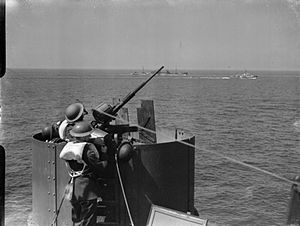


Operation MB8 was a British Royal Navy operation in the Mediterranean Sea during 4–11 November 1940. It was made up of six forces—totalling two aircraft carriers, five battleships, 10 cruisers and 30 destroyers, including much of Force H—protecting four supply convoys.[1]
It consisted of several phases: Operation Coat, Operation Crack, Convoy MW 3, Convoy ME 3, Convoy AN 6 and the main element, Battle of Taranto (Operation Judgement).[2]
Contents
1 Operation Coat
2 Convoy MW 3
3 Convoy ME 3
4 Convoy AN 6
5 Operation Crack
6 Operation Judgement
7 See also
8 Notes
9 References
Operation Coat[edit]
Operation Coat was a reinforcement convoy from Britain to Malta, carrying troops and anti-aircraft guns. The convoy was made up of the battleship HMS Barham, heavy cruisers HMS Berwick and Glasgow, and three escorting destroyers. It was covered by the aircraft carrier HMS Ark Royal, light cruiser HMS Sheffield, and three more destroyers, all from Force H, out to mid-Mediterranean; three Force H destroyers would remain, the rest turning back 165 nmi (190 mi; 306 km) from Sicily.[2]
Convoy MW 3[edit]
Convoy MW 3 was made up of three empty merchantmen bound for Malta from Alexandria, plus an Australian destroyer and the monitor HMS Terror bound for the base at Suda Bay.[3] The convoy was escorted by the anti-aircraft cruiser HMS Coventry, accompanied by three destroyers.[2] The 11.5 knots (21.3 km/h) convoy left Alexandria on 4 November and reached Malta on 10 November.[4]
Convoy ME 3[edit]
Convoy ME 3 comprised four merchantmen sailing in ballast from Malta to Alexandria, under escort of the battleship HMS Ramillies, Coventry, and two destroyers.[2] The convoy sailed from Malta on 10 November and arrived in Alexandria on 13 November.[4]
Convoy AN 6[edit]
Convoy AN 6 consisted of four slow tankers bound for Greece from Egypt,[2] in support of the British expedition there, escorted by a slow trawler.[2]
Shaping a similar course were reinforcements for Crete, embarked in light cruisers HMS Ajax and HMAS Sydney as Force B,[2] while light cruiser HMS Orion (Vice Admiral H. D. Pridham-Wippell's Force C)[5] transported RAF supplies to Greece and inspected Suda Bay.[2] All three would rejoin to form Force X for an 11/12 November raid on the Otranto Strait.[2]
Operation Crack[edit]
Operation Crack was an attack on Cagliari by aircraft from Ark Royal, en route to Malta, branching off from Operation Coat.[2]
Operation Judgement[edit]
Operation Judgement—under the overall command of Admiral A. B. Cunningham—was executed by aircraft from the carrier HMS Illustrious, escorted by battleships Ramilies, Warspite, Valiant, and Malaya. They met the heavy cruisers HMS Gloucester and York and three destroyers, then escorting Convoy MW 3, and provided cover. Then the Barham group from Operation Coat was to be met, with Illustrious, Gloucester, York, and Berwick detaching to attack Taranto, coincident with the Force X raid.
The Italians were aware of sorties from Alexandria and Gibraltar by 7 November, and sent nine submarines to attack a Malta convoy (MW 3) detected on 8 November.[2] Bombers (unsurprisingly)[6] failed even to pinpoint the Judgement force,[2] and when Force H was detected headed back toward Gibraltar on 9 November, the Italians presumed MW 3 had turned around, too.
Italian confusion arose when Barham, Berwick, Glasgow, and their destroyers were detected 10 November off Lemnos.[2] The correct deduction—they had detached from the Gibraltar-bound force—was not accompanied by a correct guess they would join with Cunningham.[7] The same day, Ramillies, Coventry, and two destroyers protecting ME 3 were detected,[2] and again, bombers failed even to locate them.[7]
The very complexity of Operation MB8, with its various forces and convoys, succeeded in deceiving the Italians into thinking only normal convoying was underway.[2] (Its success stands in stark contrast to complex Japanese failures at Coral Sea and Midway.) While Italian reconnaissance was characteristically bad,[6] in the end, the Italians had only failed to keep track of Illustrious.[7] That the Italians expected the British to behave in what was, at the time, their usual way was the root of the mistake.[7]
See also[edit]
- Battle of the Mediterranean
- Malta Convoys
- Force H
Notes[edit]
^ Stephen, pp.37-8.
^ abcdefghijklmno Stephen, p.38.
^ Greene & Massignani, p.101
^ ab Hague, p.192
^ He would later in command Light Forces in the Med. Stephen, p.50.
^ ab Stephen, p.36.
^ abcd Stephen, p.39.
References[edit]
Hague, Arnold (2000). The Allied Convoy System 1939-1945. Annapolis, Maryland: Naval Institute Press. ISBN 1-55750-019-3..mw-parser-output cite.citationfont-style:inherit.mw-parser-output .citation qquotes:"""""""'""'".mw-parser-output .citation .cs1-lock-free abackground:url("//upload.wikimedia.org/wikipedia/commons/thumb/6/65/Lock-green.svg/9px-Lock-green.svg.png")no-repeat;background-position:right .1em center.mw-parser-output .citation .cs1-lock-limited a,.mw-parser-output .citation .cs1-lock-registration abackground:url("//upload.wikimedia.org/wikipedia/commons/thumb/d/d6/Lock-gray-alt-2.svg/9px-Lock-gray-alt-2.svg.png")no-repeat;background-position:right .1em center.mw-parser-output .citation .cs1-lock-subscription abackground:url("//upload.wikimedia.org/wikipedia/commons/thumb/a/aa/Lock-red-alt-2.svg/9px-Lock-red-alt-2.svg.png")no-repeat;background-position:right .1em center.mw-parser-output .cs1-subscription,.mw-parser-output .cs1-registrationcolor:#555.mw-parser-output .cs1-subscription span,.mw-parser-output .cs1-registration spanborder-bottom:1px dotted;cursor:help.mw-parser-output .cs1-ws-icon abackground:url("//upload.wikimedia.org/wikipedia/commons/thumb/4/4c/Wikisource-logo.svg/12px-Wikisource-logo.svg.png")no-repeat;background-position:right .1em center.mw-parser-output code.cs1-codecolor:inherit;background:inherit;border:inherit;padding:inherit.mw-parser-output .cs1-hidden-errordisplay:none;font-size:100%.mw-parser-output .cs1-visible-errorfont-size:100%.mw-parser-output .cs1-maintdisplay:none;color:#33aa33;margin-left:0.3em.mw-parser-output .cs1-subscription,.mw-parser-output .cs1-registration,.mw-parser-output .cs1-formatfont-size:95%.mw-parser-output .cs1-kern-left,.mw-parser-output .cs1-kern-wl-leftpadding-left:0.2em.mw-parser-output .cs1-kern-right,.mw-parser-output .cs1-kern-wl-rightpadding-right:0.2em
Greene, Jack; Massignani, Alessandro (1998). The Naval War in the Mediterranean 1940-1943. London: Chatham Publishing. ISBN 1-885119-61-5.- Stephen, Martin. Sea Battles in Close-up: World War 2, Volume 1, pp. 37–9. Shepperton, Surrey: Ian Allan, 1988.
ISBN 0-7110-1596-1.
Categories:
- Naval battles and operations of the European theatre of World War II
- Battle of the Mediterranean
- Malta Convoys
- Naval aviation operations and battles
- Conflicts in 1940
- 1940 in Italy
- November 1940 events


(window.RLQ=window.RLQ||).push(function()mw.config.set("wgPageParseReport":"limitreport":"cputime":"0.400","walltime":"0.552","ppvisitednodes":"value":4436,"limit":1000000,"ppgeneratednodes":"value":0,"limit":1500000,"postexpandincludesize":"value":50591,"limit":2097152,"templateargumentsize":"value":7606,"limit":2097152,"expansiondepth":"value":12,"limit":40,"expensivefunctioncount":"value":2,"limit":500,"unstrip-depth":"value":0,"limit":20,"unstrip-size":"value":10405,"limit":5000000,"entityaccesscount":"value":0,"limit":400,"timingprofile":["100.00% 422.341 1 -total"," 20.54% 86.732 2 Template:Cite_book"," 19.56% 82.618 1 Template:Infobox_military_conflict"," 18.28% 77.198 16 Template:HMS"," 18.02% 76.089 17 Template:Ship"," 9.67% 40.829 2 Template:Convert"," 8.04% 33.963 1 Template:Use_dmy_dates"," 7.92% 33.450 1 Template:ISBN"," 6.37% 26.901 40 Template:Yesno"," 5.40% 22.814 1 Template:Campaignbox_Mediterranean_Campaign"],"scribunto":"limitreport-timeusage":"value":"0.117","limit":"10.000","limitreport-memusage":"value":4184307,"limit":52428800,"cachereport":"origin":"mw1246","timestamp":"20190214011620","ttl":2073600,"transientcontent":false);mw.config.set("wgBackendResponseTime":109,"wgHostname":"mw1319"););


