Walking in Space
From Wikipedia, the free encyclopedia
Jump to navigation
Jump to search
Not to be confused with Extra-vehicular activity.
| Walking in Space |
|---|
 |
Studio album by Quincy Jones
|
|---|
| Released |
1969 |
|---|
| Recorded |
June 18–19, 1969 |
|---|
| Genre |
Jazz |
|---|
| Length |
35:06 |
|---|
| Label |
A&M/CTI
|
|---|
| Producer |
Creed Taylor |
|---|
Quincy Jones chronology |
|---|
The Lost Man
(1969)
|
Walking in Space
(1969)
|
Bob & Carol & Ted & Alice
(1969)
|
|
| Professional ratings |
|---|
| Review scores |
|---|
| Source |
Rating |
|---|
| Allmusic |
 [1] [1] |
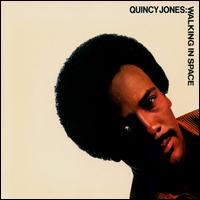
Walking in Space is a 1969 studio album by Quincy Jones.[2] The album was recorded for A&M and features an iconic photo of Quincy by Pete Turner who made some of the most famous A&M album covers. Vocalist Valerie Simpson is featured on the title track, an arrangement of a song from the hit rock musical Hair. "Dead End" is also from Hair and "Killer Joe" features Ray Brown on bass and Grady Tate on drums, an early example of a strong jazz rhythm section in pop music.
Track listing[edit]
- "Dead End" (Galt MacDermot, James Rado, Gerome Ragni) – 4:05
- "Walking in Space" (MacDermot, Rado, Ragni) – 12:06 as Hair (Original Broadway Cast Recording)
- "Killer Joe" (Benny Golson) – 5:12
- "Love and Peace" (Arthur Adams) – 5:48
- "I Never Told You" (Arthur Hamilton, Johnny Mandel) – 4:18
- "Oh Happy Day" (Edwin Hawkins) – 3:37
Personnel[edit]
Quincy Jones - conductor, arranger
Freddie Hubbard, Lloyd Michaels, Dick Williams, John Frosk, Marvin Stamm, Snooky Young – trumpet
Jimmy Cleveland, J. J. Johnson, Alan Raph, Tony Studd, Norman Pride, Kai Winding – trombone
- Joel Kaye, Roland Kirk, Hubert Laws, Jerome Richardson – reeds
Paul Griffin - piano
Eric Gale - electric guitar
Ray Brown - double bass
Grady Tate - drums
Chuck Rainey - bass on "Love and Peace"
Bob James - electric piano
Hubert Laws - flute, tenor sax
Toots Thielemans - guitar, harmonica
Bernard Purdie - drums
- Hilda Harris - vocals
- Marilyn Jackson - vocals
Valerie Simpson - vocal solo on "Walking in Space"
- Maretha Stewart - vocals
References[edit]
^ Allmusic review
^ Walking In Space at AllMusic
Quincy Jones
|
|---|
*_Awards">
|
| Albums |
- Jazz Abroad
- This Is How I Feel About Jazz
- Go West, Man!
- Quincy's Home Again
- The Birth of a Band!
- The Great Wide World of Quincy Jones
- I Dig Dancers
- Around the World
- Newport '61
- The Great Wide World of Quincy Jones Live (in Zurich!)
- The Quintessence
- Big Band Bossa Nova
- Quincy Jones Plays Hip Hits
- Quincy Jones Explores the Music of Henry Mancini
- Golden Boy
- I Had a Ball
- Quincy Plays for Pussycats
- Quincy's Got a Brand New Bag
- Walking In Space
- Gula Matari
- Smackwater Jack
- You've Got It Bad Girl
- Body Heat
- Mellow Madness
- I Heard That!!
- Roots
- Sounds...and Stuff Like That!!
- Quincy Jones Live at the Budokan
- The Dude
- Back on the Block
- Miles & Quincy Live at Montreux
- Q's Jook Joint
- Basie and Beyond
- The Original Jam Sessions 1969
- Q: Soul Bossa Nostra
|
|---|
| Compilations |
- Ndeda
- The Best
- From Q with Love
- Q The Musical Biography of Quincy Jones
|
|---|
| Singles |
- "Soul Bossa Nova"
- "Sanford and Son Theme (The Streetbeater)"
- "Stuff Like That"
- "Ai No Corrida"
- "Just Once"
- "One Hundred Ways"
- "I'll Be Good to You"
- "The Secret Garden (Sweet Seduction Suite)"
|
|---|
| Other works |
| With Michael Jackson |
- Off the Wall
- E.T. the Extra-Terrestrial
- Thriller
- Bad
- The Wiz
|
|---|
| With Frank Sinatra |
- It Might as Well Be Swing
- Sinatra at the Sands
- L.A. Is My Lady
|
|---|
| Single Collaborations |
- "It's My Party" with Lesley Gore
- "We Are the World" with USA for Africa
- "We Are the World 25 for Haiti" with Artists for Haiti
|
|---|
|
|---|
| Films |
|
|---|
Freddie Hubbard
|
|---|
Years given are for the recording(s), including the soundtrack albums, not first release. |
Albums
as
leader
or
co-leader |
Open Sesame (1960)
Goin' Up (1960)
Hub Cap (1961)
Minor Mishap/Dedication! (Hubbard/Duke Pearson, 1961)
Ready for Freddie (1961)
The Artistry of Freddie Hubbard (1962)
Hub-Tones (1962)
Here to Stay (1962)
The Body & the Soul (1963)
Breaking Point! (1964)
Jam Gems: Live at the Left Bank (with Jimmy Heath, 1965)
The Night of the Cookers (1965)
Blue Spirits (1965–66)
Backlash (1966)
High Blues Pressure (1967)
A Soul Experiment (1968–69)
The Black Angel (1969)
The Hub of Hubbard (1970)
Red Clay (1970)
Straight Life (1970)
Sing Me a Song of Songmy (with İlhan Mimaroğlu, 1970)
First Light (1971)
Polar AC (1971–73)
Sky Dive (1972)
Keep Your Soul Together (1973)
Freddie Hubbard/Stanley Turrentine in Concert
Volume One (1973)
In Concert Volume Two (with Stanley Turrentine, 1974)
High Energy (1974)
Gleam (1975)
Liquid Love (1975)
Windjammer (1976)
Bundle of Joy (1977)
Super Blue (1978)
The Love Connection (1979)
Skagly (1979)
Live at the North Sea Jazz Festival, 1980 (1980)
The Alternate Blues (with Clark Terry, Dizzy Gillespie & Oscar Peterson, 1980)
The Trumpet Summit Meets the Oscar Peterson Big 4 (with Terry, Gillespie & Peterson, 1980)
Born to Be Blue (1981)
Keystone Bop: Sunday Night (1981)
Outpost (1981)
Rollin' (1981)
Splash (1981)
Above & Beyond (1982)
Back to Birdland (1982)
Face to Face (with Oscar Peterson, 1982)
Ride Like the Wind (1982)
The Rose Tattoo (1983)
Sweet Return (1983)
Double Take (with Woody Shaw, 1985)
Life Flight (1987)
The Eternal Triangle (with Woody Shaw, 1987)
Feel the Wind (with Art Blakey, 1988)
Times Are Changing (1989)
Topsy – Standard Book (1989)
Bolivia (1990–91)
At Jazz Jamboree Warszawa '91:
A Tribute to Miles (1991)
Live at Fat Tuesday's (1991)
Blues for Miles (1992)
MMTC: Monk, Miles, Trane & Cannon (1994–95)
New Colors (2000)
On the Real Side (2007)
|
|---|
With Art
Blakey/The
Jazz
Messengers
|
Mosaic (1961)
Buhaina's Delight (1961)
Blues March (1961)
Three Blind Mice (1961)
Caravan (1962)
Ugetsu (1963)
Kyoto (1964)
Free for All (1964)
Golden Boy (1965)
Soul Finger (1965)
|
|---|
With
Dexter
Gordon
|
Doin' Allright (1961)
Clubhouse (1965)
Generation (1973)
The Other Side of Round Midnight (1986)
|
|---|
With
Herbie
Hancock
|
Takin' Off (1962)
Empyrean Isles (1964)
Maiden Voyage (1965)
Blow-Up (soundtrack album, 1966)
V.S.O.P. (1977)
V.S.O.P.: The Quintet (1977)
V.S.O.P. Tempest in the Colosseum (1977)
V.S.O.P. Live Under the Sky (1977)
Round Midnight (soundtrack album, 1985)
|
|---|
With
Bobby
Hutcherson
|
Dialogue (1965)
Components (1965)
Knucklebean (1977)
Highway One (1978)
|
|---|
With
Quincy
Jones
|
I Dig Dancers (1960)
The Quintessence (1962)
Golden Boy (1964)
I/We Had a Ball (1964–65)
Walking in Space (1969)
Gula Matari (1970)
|
|---|
With
Wayne
Shorter
|
Wayning Moments (1961)
Speak No Evil (1964)
The Soothsayer (1965)
The All Seeing Eye (1965)
|
|---|
With
others |
The Soul of the City (Manny Albam, 1966)
The Other Side of Abbey Road (George Benson, 1969)
Out of This World (Walter Benton, 1960)
True Blue (Tina Brooks, 1960)
God Bless the Child (Kenny Burrell, 1971)
Cables' Vision (George Cables, 1979)
Droppin' Things (Betty Carter, 1990)
Free Jazz (Ornette Coleman, 1960)
Olé Coltrane (John Coltrane, 1961)
Africa/Brass (John Coltrane, 1961)
Ascension (John Coltrane, 1965)
Muses for Richard Davis (1969)
Outward Bound (Eric Dolphy, 1960)
Out to Lunch! (Eric Dolphy, 1964)
Undercurrent (Kenny Drew, 1960)
Leaving This Planet (Charles Earland, 1973)
Booker 'n' Brass (Booker Ervin, 1967)
Interplay (Bill Evans, 1962)
Sonic Text (Joe Farrell, 1979)
Boss of the Soul-Stream Trombone (Curtis Fuller, 1960)
Soul Trombone (Curtis Fuller, 1961)
Cabin in the Sky (Curtis Fuller, 1962)
Take a Number from 1 to 10 (Benny Golson, 1961)
Pop + Jazz = Swing (Benny Golson, 1962)
Slide Hampton and His Horn of Plenty (1959)
Sister Salvation (Slide Hampton, 1960)
Drum Suite (Slide Hampton, 1962)
The Quota (Jimmy Heath, 1961)
Triple Threat (Jimmy Heath, 1962)
Big Band (Joe Henderson, 1996)
Pax (Andrew Hill, 1965)
Compulsion (Andrew Hill, 1965)
Sunflower (Milt Jackson, 1972)
Goodbye (Milt Jackson, 1973)
52nd Street (Billy Joel, 1978)
Reg Strikes Back (Elton John, 1988)
J.J. Inc. (J.J. Johnson, 1960)
Echoes of an Era (Chaka Khan, 1982)
Essence (John Lewis, 1960–62)
Water Sign (Jeff Lorber, 1979)
Doin' the Thang! (Ronnie Mathews, 1963)
Bluesnik (Jackie McLean, 1961)
MJQ & Friends: A 40th Anniversary Celebration (Modern Jazz Quartet, 1994)
Fingerpickin' (Wes Montgomery, 1958)
Roll Call (Hank Mobley, 1960)
The Blues and the Abstract Truth (Oliver Nelson, 1961)
Sweet Honey Bee (Duke Pearson, 1966)
The Right Touch (Duke Pearson, 1967)
Contours (Sam Rivers, 1965)
Drums Unlimited (Max Roach, 1965)
East Broadway Run Down (Sonny Rollins, 1966)
Numbers (Rufus, 1978)
Once a Thief and Other Themes (Lalo Schifrin, 1965)
Giant Box (Don Sebesky, 1973)
Sugar (Stanley Turrentine, 1970)
Together (McCoy Tyner, 1978)
Quartets 4 X 4 (McCoy Tyner, 1980)
Soundscapes (Cedar Walton, 1980)
Uhuru Afrika (Randy Weston, 1960)
Blue Moses (Randy Weston, 1972)
|
|---|

Categories:
- 1969 albums
- Quincy Jones albums
- Albums arranged by Quincy Jones
- Albums produced by Creed Taylor
- A&M Records albums
- Albums conducted by Quincy Jones
- Grammy Award for Best Large Jazz Ensemble Album
Hidden categories:
- Articles with hAudio microformats
Navigation menu
Personal tools
- Not logged in
- Talk
- Contributions
- Create account
- Log in
Navigation
- Main page
- Contents
- Featured content
- Current events
- Random article
- Donate to Wikipedia
- Wikipedia store
Interaction
- Help
- About Wikipedia
- Community portal
- Recent changes
- Contact page
Tools
- What links here
- Related changes
- Upload file
- Special pages
- Permanent link
- Page information
- Wikidata item
- Cite this page
Print/export
- Create a book
- Download as PDF
- Printable version
(window.RLQ=window.RLQ||).push(function()mw.config.set("wgPageParseReport":"limitreport":"cputime":"0.316","walltime":"0.421","ppvisitednodes":"value":1813,"limit":1000000,"ppgeneratednodes":"value":0,"limit":1500000,"postexpandincludesize":"value":94859,"limit":2097152,"templateargumentsize":"value":15331,"limit":2097152,"expansiondepth":"value":12,"limit":40,"expensivefunctioncount":"value":0,"limit":500,"unstrip-depth":"value":0,"limit":20,"unstrip-size":"value":739,"limit":5000000,"entityaccesscount":"value":0,"limit":400,"timingprofile":["100.00% 281.998 1 -total"," 49.43% 139.381 1 Template:Infobox_album"," 27.65% 77.960 1 Template:Infobox"," 18.39% 51.864 3 Template:Navbox_musical_artist"," 16.91% 47.675 3 Template:Navbox"," 14.87% 41.927 1 Template:Distinguish"," 12.18% 34.347 1 Template:Quincy_Jones"," 10.84% 30.567 1 Template:Category_handler"," 10.78% 30.404 1 Template:Album_ratings"," 7.46% 21.048 1 Template:Reflist"],"scribunto":"limitreport-timeusage":"value":"0.075","limit":"10.000","limitreport-memusage":"value":2426728,"limit":52428800,"cachereport":"origin":"mw1306","timestamp":"20190103120854","ttl":1900800,"transientcontent":false););"@context":"https://schema.org","@type":"Article","name":"Walking in Space","url":"https://en.wikipedia.org/wiki/Walking_in_Space","sameAs":"http://www.wikidata.org/entity/Q3565416","mainEntity":"http://www.wikidata.org/entity/Q3565416","author":"@type":"Organization","name":"Contributors to Wikimedia projects","publisher":"@type":"Organization","name":"Wikimedia Foundation, Inc.","logo":"@type":"ImageObject","url":"https://www.wikimedia.org/static/images/wmf-hor-googpub.png","datePublished":"2009-11-03T20:40:17Z","dateModified":"2018-10-26T00:21:27Z","image":"https://upload.wikimedia.org/wikipedia/en/8/80/Quincywalking.jpg","headline":"album by Quincy Jones"(window.RLQ=window.RLQ||).push(function()mw.config.set("wgBackendResponseTime":109,"wgHostname":"mw1324"););


