Mekosuchinae
Mekosuchinae
Jump to navigation
Jump to search
| Mekosuchinae Temporal range: Eocene - Holocene, 56–0.003 Ma PreЄ Є O S D C P T J K Pg N | |
|---|---|
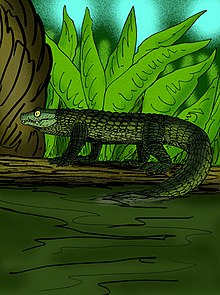 | |
| Life restoration of Mekosuchus inexpectatus | |
Scientific classification  | |
| Kingdom: | Animalia |
| Phylum: | Chordata |
| Class: | Reptilia |
| Order: | Crocodilia |
| Family: | Crocodylidae |
| Subfamily: | †Mekosuchinae Willis, Molnar & Scanlon, 1993 |
Type species | |
†Mekosuchus inexpectatus Balouet & Buffetaut, 1987 | |
Genera | |
| |
Mekosuchinae is an extinct subfamily of crocodiles from Australia and the South Pacific. They first appear in the fossil record in the Eocene in Australia, and survived until the arrival of humans-in the Pleistocene in Australia and within the Holocene in the Pacific islands of Fiji, New Caledonia and Vanuatu. There is however disagreement on whether or not Mekosuchinae is a subfamily within Crocodylidae, or a distinct family, Mekosuchidae, on its own within the superfamily Crocodyloidea.
Mekosuchine crocodiles were a diverse group. One of the last species, from Holocene New Caledonia, called Mekosuchus inexpectatus may have been arboreal.[1] The early Miocene species, Harpacochampsa camfieldensis, may have resembled a false gharial. Another mekosuchine fossil, currently undescribed, has been found in Miocene deposits from New Zealand. One genus, Mekosuchus, managed to spread to the islands of the Pacific; it is believed to have island-hopped across the Coral Sea, moving first to a now submerged island known as Greater Chesterfield Island, then New Caledonia and onwards.
In the Pleistocene, Quinkana was one of the top terrestrial predators of the Australian continent.
Mekosuchines underwent a drastic decline in post-Miocene Australia, with all genera, except for Quinkana and Pallimnarchus (both perishing during the Quaternary extinction event) becoming expirated or extinct in Australia by the end of the Pliocene. After the demise of Quinkana and Pallimnarchus, the group survived on Vanuatu and New Caledonia until the arrival of humans, who are presumed to have driven them to extinction.
References[edit]
^ Naish, Darren (13 May 2009). "The small, recently extinct, island-dwelling crocodilians of the south Pacific". Tetrapod Zoology. ScienceBlogs. Retrieved 27 November 2010..mw-parser-output cite.citationfont-style:inherit.mw-parser-output .citation qquotes:"""""""'""'".mw-parser-output .citation .cs1-lock-free abackground:url("//upload.wikimedia.org/wikipedia/commons/thumb/6/65/Lock-green.svg/9px-Lock-green.svg.png")no-repeat;background-position:right .1em center.mw-parser-output .citation .cs1-lock-limited a,.mw-parser-output .citation .cs1-lock-registration abackground:url("//upload.wikimedia.org/wikipedia/commons/thumb/d/d6/Lock-gray-alt-2.svg/9px-Lock-gray-alt-2.svg.png")no-repeat;background-position:right .1em center.mw-parser-output .citation .cs1-lock-subscription abackground:url("//upload.wikimedia.org/wikipedia/commons/thumb/a/aa/Lock-red-alt-2.svg/9px-Lock-red-alt-2.svg.png")no-repeat;background-position:right .1em center.mw-parser-output .cs1-subscription,.mw-parser-output .cs1-registrationcolor:#555.mw-parser-output .cs1-subscription span,.mw-parser-output .cs1-registration spanborder-bottom:1px dotted;cursor:help.mw-parser-output .cs1-ws-icon abackground:url("//upload.wikimedia.org/wikipedia/commons/thumb/4/4c/Wikisource-logo.svg/12px-Wikisource-logo.svg.png")no-repeat;background-position:right .1em center.mw-parser-output code.cs1-codecolor:inherit;background:inherit;border:inherit;padding:inherit.mw-parser-output .cs1-hidden-errordisplay:none;font-size:100%.mw-parser-output .cs1-visible-errorfont-size:100%.mw-parser-output .cs1-maintdisplay:none;color:#33aa33;margin-left:0.3em.mw-parser-output .cs1-subscription,.mw-parser-output .cs1-registration,.mw-parser-output .cs1-formatfont-size:95%.mw-parser-output .cs1-kern-left,.mw-parser-output .cs1-kern-wl-leftpadding-left:0.2em.mw-parser-output .cs1-kern-right,.mw-parser-output .cs1-kern-wl-rightpadding-right:0.2em
Mead, J. I.; Steadman, D. W.; Bedford, S. H.; Bell, C. J.; Spriggs, M. (August 2002). Guyer, C., ed. "New extinct mekosuchine crocodile from Vanuatu, South Pacific". Copeia. 3 (3): 632–641. doi:10.1643/0045-8511(2002)002[0632:NEMCFV]2.0.CO;2.
Categories:
- Crocodylia incertae sedis
- Ypresian first appearances
- Paleogene crocodylomorphs
- Neogene crocodylomorphs
- Holocene extinctions


(window.RLQ=window.RLQ||).push(function()mw.config.set("wgPageParseReport":"limitreport":"cputime":"0.776","walltime":"0.986","ppvisitednodes":"value":17025,"limit":1000000,"ppgeneratednodes":"value":0,"limit":1500000,"postexpandincludesize":"value":223672,"limit":2097152,"templateargumentsize":"value":25896,"limit":2097152,"expansiondepth":"value":20,"limit":40,"expensivefunctioncount":"value":3,"limit":500,"unstrip-depth":"value":1,"limit":20,"unstrip-size":"value":4980,"limit":5000000,"entityaccesscount":"value":4,"limit":400,"timingprofile":["100.00% 895.642 1 -total"," 78.05% 699.021 1 Template:Automatic_taxobox"," 18.15% 162.578 1 Template:Fossilrange"," 17.10% 153.122 1 Template:Phanerozoic_220px"," 13.85% 124.032 11 Template:Fossil_range/bar"," 13.35% 119.548 35 Template:Period_id"," 13.23% 118.458 34 Template:Period_start"," 11.79% 105.619 46 Template:Delink"," 10.34% 92.582 35 Template:MultiReplace"," 8.82% 78.973 1 Template:Reflist"],"scribunto":"limitreport-timeusage":"value":"0.540","limit":"10.000","limitreport-memusage":"value":4124618,"limit":52428800,"cachereport":"origin":"mw1348","timestamp":"20190204213722","ttl":2073600,"transientcontent":false);mw.config.set("wgBackendResponseTime":256,"wgHostname":"mw1264"););


