Portal:World War II


Before the featured portal process ceased in 2017, this had been designated as a featured portal.


Portal:World War II


From Wikipedia, the free encyclopedia

Jump to navigation
Jump to search


Wikipedia's portal for exploring content related to World War II


`


The World War II Portal


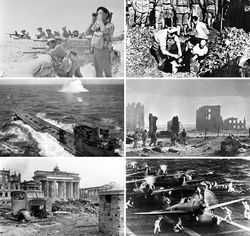
Clockwise from top left: Commonwealth troops in the desert; Chinese civilians being buried alive by Japanese soldiers; Soviet forces during a winter offensive; Carrier-borne Japanese planes readying for take off; Soviet troops fighting in Berlin; A German submarine under attack.

World War II, or the Second World War, was a global military conflict. It began as the joining of what had initially been two separate conflicts, with the first beginning in Asia in 1937 (the Second Sino-Japanese War) and the other beginning in Europe in 1939 (the German and Soviet invasion of Poland).


The war split the majority of the world's nations into two opposing military alliances: the Allies and the Axis. It involved the mobilization of over 100 million military personnel, making it the most widespread war in history, and placed the participants in a state of "total war", which erased the distinction between civil and military resources and resulted in the complete activation of a nation's economic, industrial, and scientific capabilities for the purposes of the war effort. Over 70 million people, the majority of them civilians, were killed, making it the deadliest conflict in human history.


The Allies won the war, and as a result, the Soviet Union and the United States emerged as the world's leading superpowers. This set the stage for the Cold War, which lasted for the next 45 years. The United Nations was formed in the hope of preventing another such conflict. The self-determination spawned by the war accelerated decolonization movements in Asia and Africa, while Europe itself began moving toward integration.


More about World War II...


Refresh with new selections below (purge)


Featured article


A propaganda poster calling on Australians to avenge the sinking of Australian Hospital Ship Centaur by the Japanese submarine I-177 in May 1943
Although Australia was remote from the main battlefronts, there was considerable Axis naval activity in Australian waters during World War II. A total of 54 Axis ships, both German and Japanese warships and submarines, entered Australian waters between 1940 and 1945 and attacked ships, ports and other targets. Among the best-known attacks are the sinking of HMAS Sydney by a German raider in November 1941, the bombing of Darwin by Japanese naval aircraft in February 1942, and the Japanese midget submarine attack on Sydney Harbour in May 1942. In addition, many Allied merchant ships were damaged or sunk off the Australian coast by submarines and mines. Japanese submarines also shelled several Australian ports and submarine-based aircraft flew over several Australian capital cities.The Axis threat to Australia developed gradually and until 1942 was limited to sporadic attacks by German armed merchantmen. The level of Axis naval activity peaked in the first half of 1942 when Japanese submarines conducted anti-shipping patrols off Australia's coast, and Japanese naval aviation attacked several towns in northern Australia.


...Archive/Nominations


Read more...


Selected equipment


Webley Revolver
The Webley Revolver (also known as the Webley Break-Top Revolver or Webley Self-Extracting Revolver) was, in various marks, the standard issue service pistol for the armed forces of the United Kingdom, the British Empire, and the Commonwealth from 1887 until 1963.The Webley is a top-break revolver with automatic extraction; breaking the revolver open for reloading also operates the extractor, removing the spent cartridges from the cylinder. The Webley Mk I service revolver was adopted in 1887, but it was a later version, the Mk IV, which rose to prominence during the Boer War of 1899–1902. The Mk VI, introduced in 1915 during World War I, is perhaps the best-known model. Webley service revolvers are among the most powerful top-break revolvers ever produced, firing the .455 Webley cartridge. Although the .455 calibre Webley is no longer in military service, the .38/200 Webley Mk IV variant is still in use as a police sidearm in a number of countries.The British company Webley and Scott (P. Webley & Son before merger with W & C Scott) produced a range of revolvers from the late 19th to late 20th centuries. Early models such as the Webley-Green army model 1879 and the Webley-Pryse model were first made during the 1870s.


...Archive/Nominations


Read more...


Selected battle


The U.S. cruiser Quincy on fire and sinking as a result of numerous gunfire and torpedo hits from attacking Japanese cruisers. The flames at the far left of the picture are probably from the U.S. cruiser Vincennes, also on fire from gunfire and torpedo damage.
The Battle of Savo Island, also known as the First Battle of Savo Island and, in Japanese sources, as the First Battle of the Solomon Sea (第一次ソロモン海戦, Dai-ichi-ji Soromon Kaisen), took place August 8 – August 9, 1942. It was a naval battle of the Pacific Campaign of World War II, between the Imperial Japanese Navy and Allied naval forces. The battle was the first major naval engagement of the Guadalcanal campaign.In the battle, a Japanese warship task force surprised and routed the Allied naval force, sinking one Australian and three American cruisers, while taking only moderate damage in return. The Japanese force consisted of seven cruisers and one destroyer, commanded by Vice Admiral Gunichi Mikawa. In response to Allied amphibious landings in the eastern Solomon Islands, Mikawa brought his task force down New Georgia Sound (also known as "the Slot") to attack the Allied amphibious fleet and its screening force. The screening force consisted of eight cruisers and fifteen destroyers, commanded by British Rear Admiral Victor Crutchley VC, but only five cruisers and seven destroyers were actually involved in the battle.


...Archive/Nominations


Read more...


Selected image


Crying Sudeten woman


Credit: Völkischer Beobachter
A crying Sudeten woman salutes Adolf Hitler as German forces sweep into Czechoslovakia, October 1938. Originally published in the Völkischer Beobachter, it supposedly showed the intense emotions of joy which swept the populace as Hitler drove through the streets of Cheb, 99% of whose inhabitants were ardently pro-Nazi Sudeten Germans at the time. In contrast, when the photo was published in the U.S., it was captioned, "The tragedy of this Sudeten woman, unable to conceal her misery as she dutifully salutes the triumphant Hitler, is the tragedy of the silent millions who have been 'won over' to Hitlerism by the 'everlasting use' of ruthless force." It is unknown what the true circumstances surrounding the photo are.


...Archive/Nominations


Read more...


Selected biography


George Jones

Air Marshal Sir George Jones KBE, CB, DFC (18 October 1896 – 24 August 1992) was a senior commander in the Royal Australian Air Force (RAAF). He rose from being a private soldier in World War I to Air Marshal in 1948. He served as Chief of the Air Staff from 1942 to 1952, the longest continuous tenure of any RAAF chief. Jones was a surprise appointee to the Air Force’s top role, and his achievements in the position were coloured by a divisive relationship during World War II with his head of operations and nominal subordinate, Air Vice Marshal William Bostock.Jones first saw action as an infantryman in the Gallipoli campaign of 1915, before transferring to the Australian Flying Corps the following year. Initially an air mechanic, he undertook flying training in 1917 and was posted to a fighter squadron in France, achieving seven victories to become an ace. After a short spell in civilian life following World War I, he joined the newly-formed RAAF in 1921, rising steadily through training and personnel commands prior to World War II.


...Archive/Nominations


Read more...


Did you know...?


DYKSquare.png

  • ... that the popular statement that says USS Arizona (BB-39)'s 14"/45 caliber guns were never fired in anger is a myth?
  • ...that the first time in World War II submersible tanks were used was on June 22, 1941, by German tanks of the 18th Panzer-Division?
  • ... that William T. Carneal was killed on Saipan on July 7, 1944, but his remains were not found until March 2013?


...Archive/Nominations


Read more...


Subcategories


World War II


World War II by continent


World War II by country


Lists of World War II topics


World War II-related lists


Aftermath of World War II


Aviation in World War II


Axis powers


Battles and operations of World War II


World War II casualties


Chronology of World War II


Collaboration during World War II


Cultural history of World War II


Military deception during World War II


Economic history of World War II


Friendly fire incidents of World War II


Historiography of World War II


Intelligence of World War II


World War II legislation


Military logistics of World War II


World War II and the media


Military animals of World War II


Military discipline and World War II


Military equipment of World War II


Military medicine in World War II


Military units and formations of World War II


Naval history of World War II


World War II non-governmental organizations


People of World War II


Politics of World War II


Pope Pius XII and World War II


World War II propaganda


World War II resistance movements


Science and technology during World War II


World War II sites


Sociology of World War II


Unfree labor during World War II


World War II crimes


Works about World War II


World War II naval ships


World War II stubs


Selected quote


"No enemy bomber can reach Berlin. If one reaches Berlin, my name is not Goering. You may call me Meyer."
— Hermann Göring, September, 1939
Suggest • More Quotes...


Topics


World War II
Theatres
Main events
Specific articles

Participants

Prelude

• Causes

• in Europe

• in Asia


Main theatres

• Europe

• Eastern Europe

• China

• Mediterranean, Middle East and Africa

• Asia and the Pacific

• Atlantic


General timeline

• Timeline


1939

• Invasion of Poland

• Winter War


1940

• Invasion of Denmark/Norway

• Battle of France

• Battle of Britain


1941

• Invasion of the Soviet Union

• Battle of Moscow

• Attack on Pearl Harbor


1942

• Battle of Midway

• Battle of Stalingrad

• Second Battle of El Alamein


1943

• Battle of Kursk

• Guadalcanal campaign

• Invasion of Italy


1944

• Battle of Normandy

• Operation Bagration

• Battle of Leyte Gulf

• Operation Market Garden

• Battle of the Bulge


1945

• Battle of Iwo Jima

• Battle of Okinawa

• Battle of Berlin

• End in Europe

• Hiroshima and Nagasaki

• Surrender of Japan


more...


• Blitzkrieg

• Cryptography

• Equipment

• Home Front

• Military engagements

• Production

• Resistance

• Technology


Civilian impact and atrocities

• Nanking Massacre

• The Holocaust

• Siege of Leningrad

• Bataan Death March

• Dutch famine of 1944

• Bengal famine of 1943

• Hiroshima and Nagasaki

• Unit 731

• Strategic bombings

• Comfort women

• Allied war crimes

• German war crimes

• Japanese war crimes


Aftermath

• Effects

• Casualties

• Expulsion of Germans

• Denazification

• Cold War

• Universal Declaration of Human Rights

• Decline of the British Empire


The Allies

Australia Australia

Belgium Belgium

Brazil Brazil

British Raj British India

Canada Canada

Czechoslovakia Czechoslovakia

Kingdom of Egypt Egypt

El Salvador El Salvador

French Third Republic France (after June 16, 1940: Free France Free France)

Kingdom of Greece Greece

Netherlands Netherlands

Dominion of New Zealand New Zealand

Norway Norway

Commonwealth of the Philippines Philippines

Poland Poland

Republic of China (1912–1949) Republic of China

Union of South Africa South Africa

Soviet Union Soviet Union

United Kingdom United Kingdom

United States United States

Kingdom of Yugoslavia Yugoslavia


more...


The Axis

Kingdom of Bulgaria Bulgaria

 IS Croatia

Empire of Japan Japan

Finland Finland

 Vichy France

Kingdom of Hungary (1920–1946) Hungary

Kingdom of Italy Italy

Nazi Germany Germany

Kingdom of Romania Romania

Thailand Thailand

 Slovakia


more...


Things you can do


From the World War II task force of the Military history WikiProject:


Attention needed


...to referencing and citation  • ...to coverage and accuracy  • ...to structure  • ...to grammar  • ...to supporting materials 

Popular pages

Full list

Cleanup needed


Battle of Kiev (1943) • Battle of Ko Chang • Colditz Castle • Spiritual national defence • Tuskegee Airmen

Requested articles 


Battle of Uhtua-Kiestinki • Battles of Repola-Rukajärvi • Battle of Siiranmäki • Battle of Łuck • Battle of Równe • Battle of Włodzimierz Wołyński • Battle of Lubartów • Battle of Miedniki • Battle of Jodła • Francis Blanchain • Shinshou Draenger • Christer Lyst Hansen • Holocaust slave labor litigation • Ove Kampman • League for Combat Policy • Frederick Charles Lough • Julien Meline • Operation Bigot • Operation Mittelmeer • Operation Richard • Otto Program • Martin Poppel • Roehm's Avengers • Dorothy Tartiere • Poul Bruun • Raoul Boulanger • Serge Asher-Ravanel • Battle of West Ukraine (1941) • Battle of Zunyi • Free Dutch Forces (draft, please assist) • Liberation of Denmark (currently redirect) • Operation Vado (currently redirect) • Finnish 19th Division (Continuation War) • Finnish 11th Division (Continuation War) • Finnish VII Corps (Continuation War) • Finnish VI Corps (Continuation War) • Finnish IV Corps (Continuation War) • Finnish Cavalry Brigade • 1st Jaeger Brigade • 2nd Jaeger Brigade • Finnish 1st Division (Continuation War) • 168th Rifle Division (Soviet Union) • 71st Rifle Division (Soviet Union) • Group Oinonen • A.S. Ksenofontov (ru) • Ponomarev Dmitry Grigorievich (ru) (ref) • Siege of Tobruk (June 1942) (ref)

Expansion needed


Princess Irene Brigade • Battle of Bay of Viipuri • Demilitarisation; Martha Desrumeaux • Mochitsura Hashimoto • Operation Cascade • Operation Tan No. 2 • Burma Area Army • Battle of Courland • Battle of Munda Point • Battle of Voronezh (1943) • Drive on Munda Point • First Battle of Kharkov • Race to Berlin • Marie Fourcade • Victor Strydonck de Burkel • Donald Blakeslee • Operation Nordwind • Battle of Skerki Bank • Michael Sinclair (soldier) • Battle of Maastricht • Battle of Zeeland • Landings on Rendova • New Georgia counterattack • Operation Waterfall • Petsamo–Kirkenes Offensive • Raid on Choiseul • American-British-Dutch-Australian Command • Battle of Viru Harbor • Battle of Wickham Anchorage • Western New Guinea campaign (and the individual battles of the campaign) • Operation Blockbuster • more

Images needed


Twelfth Army (United Kingdom) • 4th Airborne Division (United Kingdom) • 5th Airborne Division (United Kingdom) • XVI Corps (United Kingdom) • Battle of Dakar • Battle of the Lys (1940) • Battle of Zeeland • Battle of the Grebbeberg • Franco-Thai War • Battle of Ko Chang • Switzerland during the World Wars • Berthe Fraser • Dietrich von Saucken

Merging needed

Add an article here!

Citations needed


Battle of Borneo (1941–42) • Garderegiment Fuseliers Prinses Irene • Japanese invasion of French Indochina • Japanese invasion of Thailand • Luxembourg in World War II • New Georgia Campaign • Operation Cartwheel • Operation Chastise • Royal Netherlands Motorized Infantry Brigade • Solomon Islands campaign

Translation needed 

pt:Tobrouk (militar)


Associated Wikimedia


The following Wikimedia Foundation sister projects provide more on this subject:


Wikibooks

Books


Commons

Media


Wikinews 

News


Wikiquote 

Quotations


Wikisource 

Texts


Wikiversity

Learning resources


Wiktionary 

Definitions


Wikidata 

Database


  • What are portals?

  • List of portals


Portal topics

Activities

Culture

Geography

Health

History

Mathematics

Nature

People

Philosophy

Religion

Society

Technology

Random portal


Retrieved from "https://en.wikipedia.org/w/index.php?title=Portal:World_War_II&oldid=871868834"


Navigation menu


(window.RLQ=window.RLQ||).push(function()mw.config.set("wgPageParseReport":"limitreport":"cputime":"0.596","walltime":"1.012","ppvisitednodes":"value":4373,"limit":1000000,"ppgeneratednodes":"value":0,"limit":1500000,"postexpandincludesize":"value":152495,"limit":2097152,"templateargumentsize":"value":22986,"limit":2097152,"expansiondepth":"value":17,"limit":40,"expensivefunctioncount":"value":2,"limit":500,"unstrip-depth":"value":0,"limit":20,"unstrip-size":"value":18080,"limit":5000000,"entityaccesscount":"value":0,"limit":400,"timingprofile":["100.00% 682.459 1 -total"," 24.16% 164.866 1 Portal:World_War_II/Topics"," 21.76% 148.531 5 Template:Random_portal_component"," 20.01% 136.526 30 Template:Flagicon"," 11.80% 80.537 1 Portal:World_War_II/Did_you_know"," 11.22% 76.605 3 Template:Random_subpage"," 10.81% 73.802 1 Template:Portal_maintenance_status"," 9.24% 63.063 12 Template:Box-header"," 6.99% 47.706 1 Template:Random_portal_component_with_nominate"," 6.94% 47.365 6 Portal:World_War_II/box-header"],"scribunto":"limitreport-timeusage":"value":"0.131","limit":"10.000","limitreport-memusage":"value":3139115,"limit":52428800,"cachereport":"origin":"mw1240","timestamp":"20190220210109","ttl":21600,"transientcontent":true);mw.config.set("wgBackendResponseTime":96,"wgHostname":"mw1262"););

Popular posts from this blog

27

Top Tejano songwriter Luis Silva dead of heart attack at 64

Category:Rhetoric