Southern Ndebele language
Southern Ndebele language
Jump to navigation
Jump to search
| Southern Ndebele | |
|---|---|
| Transvaal Ndebele | |
| isiNdebele seSewula | |
| Native to | South Africa |
| Region | Mpumalanga, Limpopo, Gauteng, North West |
Native speakers | 1.1 million (2011 census)[1] 1.4 million L2 speakers (2002)[2] |
Language family | Niger–Congo
|
Writing system | Latin (Ndebele alphabet) Ndebele Braille |
Signed forms | Signed Ndebele |
| Official status | |
Official language in |  South Africa South Africa |
| Language codes | |
| ISO 639-1 | nr – South Ndebele |
| ISO 639-2 | nbl – South Ndebele |
| ISO 639-3 | nbl – South Ndebele |
| Glottolog | sout2808[3] |
Guthrie code | S.407[4] |
| Linguasphere | 99-AUT-fi + 99-AUT-fj |

Geographical distribution of isiNdebele in South Africa: proportion of the population that speaks isiNdebele at home. .mw-parser-output div.columns-2 div.columnfloat:left;width:50%;min-width:300px.mw-parser-output div.columns-3 div.columnfloat:left;width:33.3%;min-width:200px.mw-parser-output div.columns-4 div.columnfloat:left;width:25%;min-width:150px.mw-parser-output div.columns-5 div.columnfloat:left;width:20%;min-width:120px
| 0–20% 20–40% 40–60% | 60–80% 80–100% |

Geographical distribution of isiNdebele in South Africa: density of isiNdebele home-language speakers.
| <1 /km² 1–3 /km² 3–10 /km² 10–30 /km² 30–100 /km² | 100–300 /km² 300–1000 /km² 1000–3000 /km² >3000 /km² |
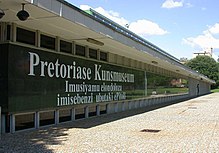
Bilingual sign in Afrikaans and Transvaal Ndebele at the Pretoria Art Museum
Southern Ndebele (English: /ɛndəˈbiːliː/), also known as Transvaal Ndebele[1] or South Ndebele,[5][6] is an African language belonging to the Nguni group of Bantu languages, spoken by the Ndebele people of South Africa.
There is also a different language called Northern Ndebele, or isiNdebele, Matabele, or simply Ndebele, spoken in Zimbabwe, which is closer to Zulu than other Nguni dialects.[7][8]
Contents
1 Overview
2 Phonology
2.1 Vowels
2.2 Consonants
2.3 Click consonants
3 Examples
4 AmaNdebele in Zimbabwe
5 References
6 External links
6.1 Software
Overview[edit]
The Southern Transvaal Ndebele people's history has been traced back to King Ndebele, King Ndebele fathered King Mkhalangana, King Mkhalangana fathered King Mntungwa (not to be confused with the Khumalo Mntungwa, because he was fathered by Mbulazi), King Mntungwa fathered King Jonono, King Jonono fathered King Nanasi, King Nanasi fathered King Mafana, king Mafana fathered King Mhlanga and Chief Libhoko, King Mhlanga fathered King Musi and Chief Skhube.
Ndebele – Some of his sons were left behind with the Hlubi tribe
Mkhalangana – Some of his sons branched and formed the Kalanga tribe
Mntungwa – Founder of the amaNtungwa clan
Njonono – He died in Jononoskop near Ladysmith – Surname Jonono is in the Hlubi tribe
Nanasi – He died in Jononoskop near Ladysmith – Surname Nanasi is in the Hlubi tribe
Mafana – He died in Randfontein (Emhlangeni)
Mhlanga – He died in Randfontein (Emhlangeni)
Musi – He died in kwaMnyamana (Pretoria)
King Musi's kraal was based at eMhlangeni a place named after his father Mhlanga, the name of the place is currently known as Randfontein (Mohlakeng) and later moved to KwaMnyamana which is now called Emarula or Bon Accord in Pretoria.
King Musi was a polygamist and fathered the following sons, Skhosana (Masombuka), Manala (Mbuduma), Ndzundza (Hlungwana), Thombeni (Kekana or Gegana), Sibasa, Mhwaduba (Lekhuleni) and Mphafuli and others.
Southern Transvaal Ndebele is one of the eleven official languages in the Republic of South Africa. The language is a Nguni or Zunda classification (UN) spoken mostly in the Mpumalanga Province, Gauteng, Limpopo and the Northwest.
The expression "isikhethu" can be loosely translated to mean 'the Southern Ndebele way of doing or saying'. Isikhethu means Southern Ndebele the same way that sikitsi will mean Swazi and se harona will mean Sotho.
The language has been severely marginalised over the years. Until the formation of the apartheid Southern Ndebele homeland (KwaNdebele), speaking the language publicly was discouraged. Most Southern Transvaal Ndebele speakers preferred Zulu especially because the latter was learned at school. Today the Southern Ndebele speakers, mostly those who are educated still prefer to use Southern Ndebele as home language for their children and will use Southern Ndebele as a language to communicate with other Southern Ndebele speakers.
Phonology[edit]
Vowels[edit]
Front | Back | |
|---|---|---|
Close | i [i] | u [u] |
Mid | e [e~ɛ] | o [o~ɔ] |
Open | a [a] | |
Consonants[edit]
Bilabial | Labio- dental | Alveolar | Palatal | Velar | Glottal | ||
|---|---|---|---|---|---|---|---|
Plosive | ejective | p [pʼ] | t [tʼ] | k [kʼ] | |||
aspirated | ph [pʰ] | th [tʰ] | kh [kʰ] | ||||
devoiced | bh [b̥] | d [d̥] | ɡ [ɡ̊] | ||||
prenasal | mp [ᵐp] | nt [ⁿt] | nk [ᵑkʼ] | ||||
prenasal (vd.) | mb [ᵐb] | nd [ⁿd] | ng [ᵑɡ] | ||||
implosive | b [ɓ] | ||||||
Fricative | plain | f [f] | s [s] | rh [x] | |||
voiced | v [v] | z [z] | h [ɦ] | ||||
prenasal | mf [ɱf] | ||||||
prenasal (vd.) | mv [ɱv] | ||||||
Nasal | m [m] | n [n] | ny [ɲ] | ngh [ŋ] | |||
Lateral Fricative | plain | hl [ɬ] | |||||
voiced | dl [ɮ] | ||||||
aspirated | dlh [ɮʰ] | ||||||
Rhotic | r [r] | ||||||
Lateral Approximant | l [l] | ||||||
Approximant | w [w] | y [j] | |||||
Alveolar | Post- alveolar | Velar | |||
|---|---|---|---|---|---|
Affricate | voiceless | ejective | ts [tsʼ] | tj [tʃʼ] | kg [kxʼ] |
aspirated | tsh [tsʰ] | tjh [tʃʰ] | kgh [kxʰ] | ||
lateral | tl [tɬʼ] | ||||
lateral (asp.) | tlh [tɬʰ] | ||||
voiced | plain | dz [dz] | |||
devoiced | j [d̥ʒ] | ||||
prenasal | nj [ᶮdʒ] | ||||
Consonant sounds nt, nd, k, mf, and mv often result in allophones of [d̥r dr k̬ ɱp̪fʼ ɱb̪v].[9]
Click consonants[edit]
Dental | Post- alveolar | Lateral | |||
|---|---|---|---|---|---|
Plosive | voiceless | plain | c [ǀ] | q [!] | |
aspirated | ch [ǀʰ] | qh [!ʰ] | |||
nasalized | nc [ᵑǀ] | nx [ᵑǁ] | |||
voiced | plain | gc [ǀᶢ] | gq [!ᶢ] | ||
nasalized | ngq [ᵑ!ᶢ] | ||||
Examples[edit]
Months in Southern Ndebele
| English | Northern Ndebele (Zimbabwe) | Southern Ndebele (South Africa) |
|---|---|---|
| January | uZibandlela | uTjhirhweni |
| February | uNhlolanja | uMhlolanja |
| March | uMbimbitho | uNtaka |
| April | uMabasa | uSihlabantangana |
| May | uNkwekwezi | uMrhayili |
| June | uNhlangula | uMgwengweni |
| July | uNtulikazi | uVelabahlinze |
| August | uNcwabakazi | uRhoboyi |
| September | uMpandula | uKhukhulamungu |
| October | uMfumfu | uSewula |
| November | uLwezi | uSinyikhaba |
| December | uMpalakazi | uNobayeni |
AmaNdebele in Zimbabwe[edit]
Ndebele/ Zimbabwean Ndebele (Northern Ndebele) is part of the Zunda sub-group of the Nguni languages and is similar to Xhosa and Zulu, while the South African (or Southern Transvaal Ndebele), while maintaining its Nguni roots, has been more influenced by the Sotho languages.[9] Southern Transvaal Ndebele and Ndebele are both part of the Nguni language group and are therefore share a few words in common.[10]
References[edit]
^ ab Ndebele at Ethnologue (18th ed., 2015)
^ Webb, Vic. 2002. "Language in South Africa: the role of language in national transformation, reconstruction and development." Impact: Studies in language and society, 14:78
^ Hammarström, Harald; Forkel, Robert; Haspelmath, Martin, eds. (2017). "Sumayela Ndebele". Glottolog 3.0. Jena, Germany: Max Planck Institute for the Science of Human History..mw-parser-output cite.citationfont-style:inherit.mw-parser-output .citation qquotes:"""""""'""'".mw-parser-output .citation .cs1-lock-free abackground:url("//upload.wikimedia.org/wikipedia/commons/thumb/6/65/Lock-green.svg/9px-Lock-green.svg.png")no-repeat;background-position:right .1em center.mw-parser-output .citation .cs1-lock-limited a,.mw-parser-output .citation .cs1-lock-registration abackground:url("//upload.wikimedia.org/wikipedia/commons/thumb/d/d6/Lock-gray-alt-2.svg/9px-Lock-gray-alt-2.svg.png")no-repeat;background-position:right .1em center.mw-parser-output .citation .cs1-lock-subscription abackground:url("//upload.wikimedia.org/wikipedia/commons/thumb/a/aa/Lock-red-alt-2.svg/9px-Lock-red-alt-2.svg.png")no-repeat;background-position:right .1em center.mw-parser-output .cs1-subscription,.mw-parser-output .cs1-registrationcolor:#555.mw-parser-output .cs1-subscription span,.mw-parser-output .cs1-registration spanborder-bottom:1px dotted;cursor:help.mw-parser-output .cs1-ws-icon abackground:url("//upload.wikimedia.org/wikipedia/commons/thumb/4/4c/Wikisource-logo.svg/12px-Wikisource-logo.svg.png")no-repeat;background-position:right .1em center.mw-parser-output code.cs1-codecolor:inherit;background:inherit;border:inherit;padding:inherit.mw-parser-output .cs1-hidden-errordisplay:none;font-size:100%.mw-parser-output .cs1-visible-errorfont-size:100%.mw-parser-output .cs1-maintdisplay:none;color:#33aa33;margin-left:0.3em.mw-parser-output .cs1-subscription,.mw-parser-output .cs1-registration,.mw-parser-output .cs1-formatfont-size:95%.mw-parser-output .cs1-kern-left,.mw-parser-output .cs1-kern-wl-leftpadding-left:0.2em.mw-parser-output .cs1-kern-right,.mw-parser-output .cs1-kern-wl-rightpadding-right:0.2em
^ Jouni Filip Maho, 2009. New Updated Guthrie List Online
^ "Documentation for ISO 639 identifier: nbl". ISO 639-2 Registration Authority - Library of Congress. Retrieved 2017-07-04.Name: South Ndebele
^ "Documentation for ISO 639 identifier: nbl". ISO 639-3 Registration Authority - SIL International. Retrieved 2017-07-04.Name: South Ndebele
^ Skhosana, Philemon. "The (ama)Ndebele of Africa and their name '(ama)Ndebele'". University of Pretoria – Department of Library Services. University of Pretoria. Retrieved 24 March 2016.
^ www.northernndebele.blogspot.com
^ ab Skhosana, P.B. (2010) The Linguistic Relationship between Southern and Northern Ndebele, University of Pretoria, DLitt Thesis
^ www.northernndebele.blogspot.com
External links[edit]
 | Southern Ndebele language test of Wikipedia at Wikimedia Incubator |
- List links to Ndebele language resources
The 1971 Pelling lexicon of Ndebele->English (text file) (on a stable Archive.org link)
CBOLD – Comparative Bantu Online Dictionary – including Ndebele
Software[edit]
Spell checker for OpenOffice.org and Mozilla, OpenOffice.org, Mozilla Firefox web-browser, and Mozilla Thunderbird email program in Ndebele- Project to translate Free and Open Source Software into Ndebele
| Languages of South Africa | |||||||||||||
|---|---|---|---|---|---|---|---|---|---|---|---|---|---|
| *_Commission_for_Cultural,_Religious_and_Linguistic_Community_Rights *_Department_of_Arts_and_Culture">
| |||||||||||||
| Official |
| ||||||||||||
| Recognised unofficial languages mentioned in the 1996 constitution |
| ||||||||||||
| Other |
| ||||||||||||
Authority control  |
|
|---|
Categories:
- Ndebele
- Nguni languages
- Languages of South Africa


(window.RLQ=window.RLQ||).push(function()mw.config.set("wgPageParseReport":"limitreport":"cputime":"0.860","walltime":"1.076","ppvisitednodes":"value":5975,"limit":1000000,"ppgeneratednodes":"value":0,"limit":1500000,"postexpandincludesize":"value":607094,"limit":2097152,"templateargumentsize":"value":11202,"limit":2097152,"expansiondepth":"value":16,"limit":40,"expensivefunctioncount":"value":4,"limit":500,"unstrip-depth":"value":1,"limit":20,"unstrip-size":"value":15499,"limit":5000000,"entityaccesscount":"value":1,"limit":400,"timingprofile":["100.00% 669.095 1 -total"," 42.56% 284.781 1 Template:Infobox_language"," 35.39% 236.812 1 Template:Infobox"," 26.26% 175.723 2 Template:Navbox_with_collapsible_groups"," 20.87% 139.655 26 Template:Navbox"," 15.52% 103.819 1 Template:Narrow_Bantu_languages"," 12.94% 86.612 1 Template:Glottolog"," 12.47% 83.467 1 Template:Cite_book"," 7.08% 47.399 1 Template:Authority_control"," 6.27% 41.951 1 Template:EngvarB"],"scribunto":"limitreport-timeusage":"value":"0.245","limit":"10.000","limitreport-memusage":"value":6182193,"limit":52428800,"cachereport":"origin":"mw1249","timestamp":"20190119113229","ttl":86400,"transientcontent":true);mw.config.set("wgBackendResponseTime":86,"wgHostname":"mw1244"););


